
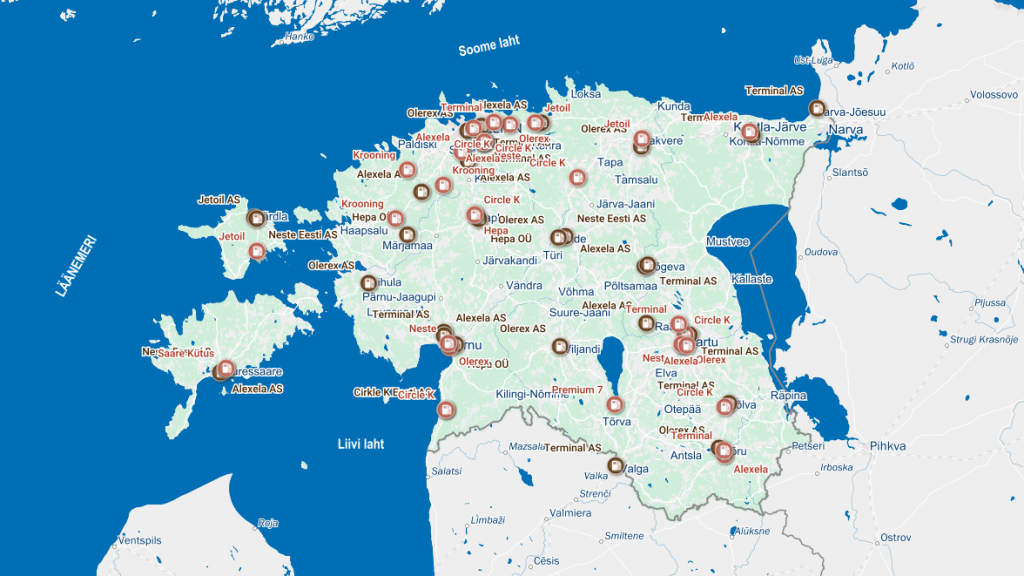
Larger filling station chains have been required from 2022 onwards to equip at least three filling stations with autonomous electric power and to keep at least 10 thousand litres of petrol and diesel in storage at all times to ensure the provision of a vital service. There are a total of 30 official emergency filling stations in Estonia that meet these requirements.
According to Priit Enok, Member of the Management Board of the Estonian Stockpiling Agency, the number of official emergency filling stations is not sufficient to for a major crisis and they are not spread evenly across the country.
‘We knew that the fuel companies had other generator-equipped filling stations. We asked if they are willing to disclose their location. We added an extra layer of data to the map which added about the same number of filling stations equipped with generators, and the number of areas not covered by the service decreased significantly. Thus, there are currently at least 60 filling stations with increased crisis preparedness in Estonia, and more are sure to be added. We hope that the map update will make fuel buyers more aware of filling stations that are most likely to be able to provide fuel in a crisis. On the other hand, we would like motorists to be prepared to help themselves, rather than being the first to rush to a filling station in the event of a power cut. You should always have at least half a tank of fuel, just in case,’ said Enok.
Official emergency filling stations are subject to strict requirements laid down in a ministerial decree and are monitored by the Ministry of Climate in cooperation with the Consumer Protection and Technical Regulatory Authority. The filling stations included as an additional layer on the map have been made more resilient by the fuel companies on their own initiative, and the filling station operators are responsible for keeping this information up-to-date in the map application.
At the request of the Estonian Stockpiling Agency, Turu-Uuringute AS carried out an omnibus survey this spring on the consumption of fuel by Estonian residents and their opinions on their ability to cope in a crisis.
55% of car owners surveyed are worried about whether they will be able to buy fuel during a crisis. 77% of Estonian families owning a car say they can handle a week without refuelling without having to change their way of life.
Less than a third (28%) of respondents who own a car know the location of the nearest filling station, and the same number of people know how to find the information they need.
Consistently filling up a car at half a tank is not widespread among car-owning households. 43% of car owners say they do it at first opportunity. The 65–74 age group (62%) and 75+ age group (70%) were the age groups most likely to mention the habit of driving with a full tank, whereas only 23–30% of younger people say they drive with a full tank.
Compared to 2022, the number of car-owning households who keep some fuel at home has doubled (2022 – 14%; 2025 – 29%). Keeping a reasonable supply of petrol or diesel at home is only recommended if there are safe storage conditions, for example in a private house or in a rural area.
AS Eesti Varude Keskus is a state-owned company that manages the strategic stockpiles of Estonia, including liquid fuels. The state stock of liquid fuels lasts for 90 days under normal consumption. In addition, our fuel companies have significant commercial stocks – 118 days for petrol and 26 days for diesel as at 30 April.

