
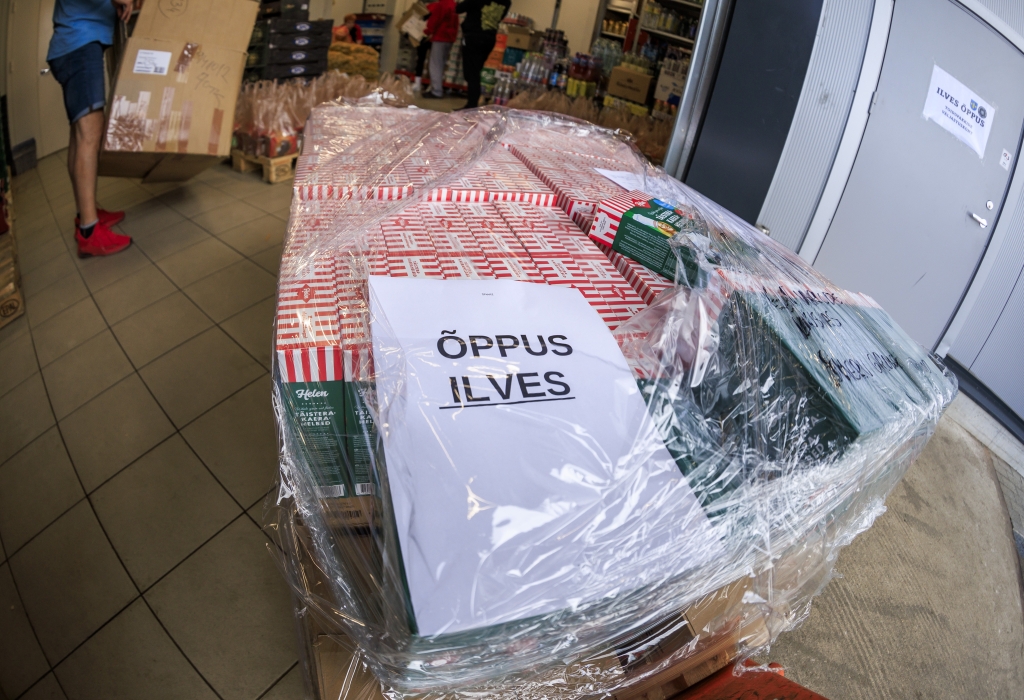
The sub-exercise took place in four local authorities: In Rakvere Parish, North Pärnu County, the city of Tallinn, and the city of Keila. During the exercise, logistics partners transported food from the warehouses of the partners of the Estonian Stockpiling Agency to locations designated by local authorities. Local authorities organised food distribution to the public in accordance with local circumstances and needs, using either local shops or their own infrastructure. In Rakvere Parish, for example, food parcels containing a three-day stock of food for one person were distributed to local residents with the help of partners.
According to Maido Nõlvaku, the municipality mayor of Rakvere Parish, the exercise went very well. ‘It was very interesting to take part in an exercise that presented us with a completely new kind of challenge – distributing food in a crisis situation. The fact that we didn’t just practise this on paper, but actually did it in real life with the local residents, was particularly useful. Cooperation between all parties was very smooth, and I am particularly pleased that the local people played an active part in the exercise – even more actively than we had initially anticipated. Such comprehensive exercises are essential, as they allow future scenarios to be simulated in real-life situations. We would probably act in much the same way in a real crisis as we do today. We also received confirmation that, if necessary, we are ready to supply the national food stock to all residents of our municipality – that is, around 6,000 people,’ said Nõlvak.
The exercise confirmed that food security is not just about physical stocks, but about the readiness of the entire food supply chain. The priority of the Ministry of Regional Affairs and Agriculture is a strong domestic agricultural sector and a sustainable food industry, which form the basis of food security. Stocks also play a key role in food security. Both domestic and national. The role of the Ministry is to ensure that food is available to the public in any crisis – from Estonian farmers’ produce and the functioning of the food industry to the retail network and distribution capacity that is activated during a crisis.
According to Toomas Unt, the Crisis Manager at the Ministry of Regional Affairs and Agriculture, it is important that food security is multi-layered in a crisis situation. ‘Initially, existing commercial stocks in shops and warehouses can be utilised if necessary, but in a situation where borders are closed, the system will rely on Estonia’s self-sufficiency and domestic food production. The state’s physical food stocks are just one tool among many. The strategic objective is to keep the food supply chain functioning so that production, processing, logistics, and distribution are not disrupted, even in difficult circumstances. During this exercise, we practised procedures related to the mobilisation of the operational stockpile of the state,’ explained Unt.
The large-scale national defence exercise ILVES 2026 is one of the largest crisis exercises of Estonia. Organised by the Government Office in collaboration with the Ministry of the Interior and other partners, the exercise will involve around 150 organisations and an estimated 3,000 people from across Estonia. A total of 38 sub-exercises and 69 training sessions are planned. The aim of the exercise is to practise resolving various crisis situations through cooperation, to strengthen cooperation between agencies, and to enhance the preparedness and resilience of society as a whole.
Press release from the Ministry of Regional Affairs
Photo gallery: Practising the mobilisation of the national food stock in Rakvere Parish as part of the large-scale exercise ‘Ilves’ on 10 June 2026.


