
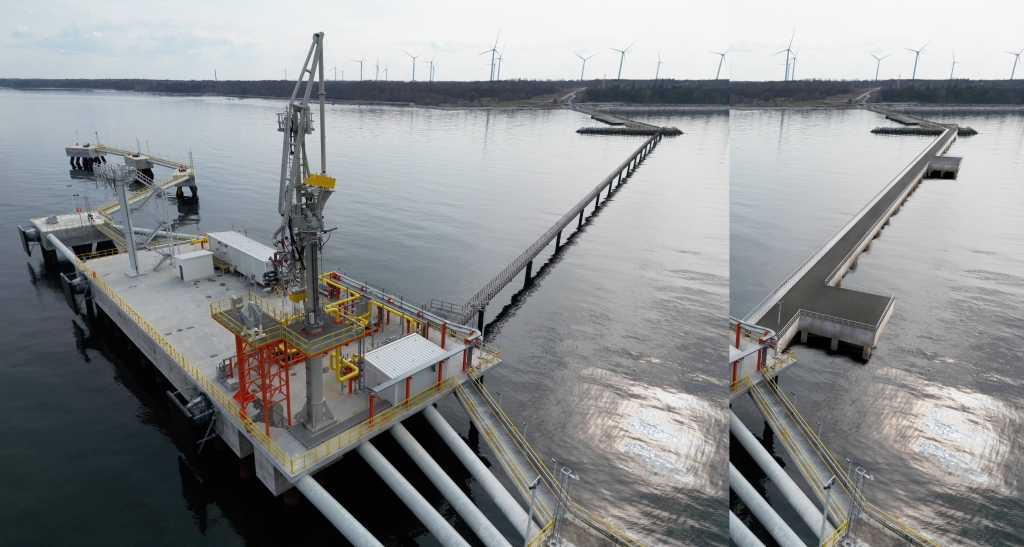
In order to construct the permanent connecting road, ESPA signed a general contracting agreement with AS Insenerehitus in April this year. The contract value of the construction project, which began in the last week of June, is 6.5 million euros, and the work must be completed by October 2027 at the latest. The road was designed by ConX PM OÜ.
According to Ando Leppiman, Chairman of the Board of ESPA, this is a significant investment in the development of infrastructure that ensures Estonia’s gas security.
‘In addition to our people, employees of the owner of the gas network Elering, port authority Tallinna Sadam, security company G4S, and other contract partners of the Estonian Stockpiling Agency must also have access to the jetty. With the arrival of the floating terminal for liquefied natural gas – the FSRU –, there will be even more movement between the jetty and the shore, and it is not reasonable to do all this via a service vessel. Establishing a permanent connection between the jetty and the port area is necessary not only to meet current needs, but also to expand the commercial opportunities of port operations so that, in the future, we could handle gaseous and future fuels such as hydrogen and its derivatives,’ said Leppiman.
During the construction of the liquefied natural gas (LNG) receiving jetty at the Port of Pakrineeme, a temporary breakwater and a 380-metre metal lattice gangway were built out into the sea to facilitate the construction of the jetty. Both the existing footpath and the breakwater have been constructed as temporary solutions; they are not intended for permanent, long-term use and are in need of renovation.
Construction work on the new connecting road is being carried out mainly from the sea using a floating crane. Particular attention is paid to minimising the environmental impact of the construction. Due to the construction technology used, no sediment is released into the water, as the works do not involve filling or dredging the seabed. The new piles for the access road will be installed using the vibration method rather than pile driving, thereby avoiding the noise associated with conventional construction work. The rate of pile installation averages two piles per day.
The project’s long completion timeframe is due to the need to comply with the results of environmental studies and to observe the spring and autumn construction moratoriums. Furthermore, work carried out at sea is heavily dependent on wintry weather conditions, which is why the overall duration of the project is longer than the actual time taken for the construction work.
During the construction period, there will be no direct connection between the jetty and the mainland. Access to the jetty will be ensured during this period in accordance with the cooperation agreement concluded between EVK and the State Fleet.
Located on the northern coast of the Pakri Peninsula in Lääne-Harju Municipality, the Port of Pakrineeme is an infrastructure facility of strategic importance to Estonia’s energy security; it enables the reception of liquefied natural gas when necessary and will also support the handling of other gaseous energy sources and future fuels in the future. The Port of Pakrineeme is owned by the state and managed by the Estonian Stockpiling Agency.


